
The following is part of a series of profiles highlighting various local education agencies’ (LEAs) efforts to develop quality arts education programming for their students. These profiles intend to support LEAs in generating ideas for effective arts programming that school leaders could implement with Prop 28 funding in different contexts.
Live Oak School District: Effectively Using a VAPA TOSA
Overview
Located in South Santa Cruz County, California, Live Oak School District serves nearly 1,500 TK– 8 students across three elementary schools, one middle school, one charter school, and one alternative/online school. In this small community, Live Oak School District has been working to fulfill its mission, “empower, inspire, and ensure equitable opportunities for every student to thrive,” including equitable access to arts programming for all their students. The district has made a strategic investment by employing a Visual and Performing Arts Teacher on Special Assignment (VAPA TOSA). This position has been a critical lever for the district to ensure arts are prioritized.
Background Information
- Regional information
- District Name: Live Oak School District
- County Name: Santa Cruz County
- California County Superintendents Service Region: Region 5
- School information
- Number of Schools: 6
- Urban, rural, suburban classification: Urban
- Teacher information (2021–22)
- Total number of FTE teachers in district: 90.7
Table 1. Snapshot of 2021–22 Teaching Assignment by FTE: Live Oak School District

Data from the California Department of Education. Retrieved May 6, 2024, from
https://dq.cde.ca.gov/dataquest/DQCensus/TchAssgnOutcome.aspx?cds=4469765&agglevel=District&year=2021-22&ListReportRows=Subj&charter=All&Display=Pct&ro=1
4. Student information (2022–23)
-
- Number of students served: 1691
- Percentage of English language learner (ELL) students: 16.9%
- Percentage of students who qualify for free or reduced-price lunch (FRL): 71.8%
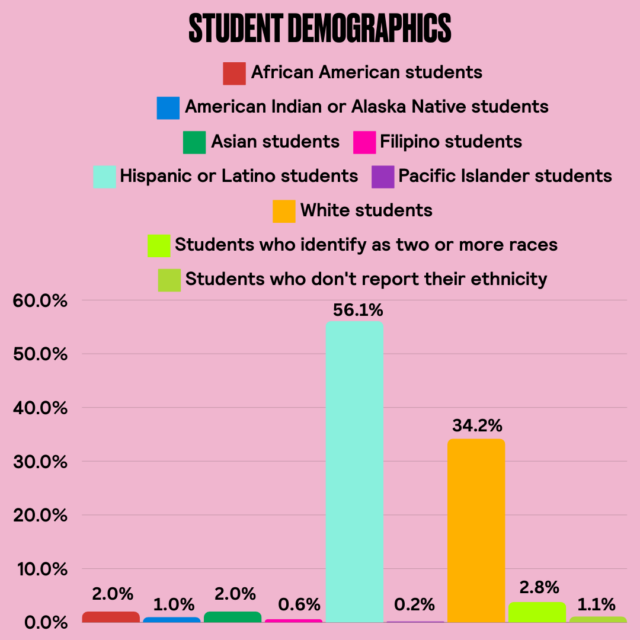
- Demographics of students
- Percentage of African American students: 2.0%
- Percentage of American Indian or Alaska Native students: 1.0%
- Percentage of Asian students: 2.0%
- Percentage of Filipino students: 0.6%
- Percentage of Hispanic or Latino students: 56.1%
- Percentage of Pacific Islander students: 0.2%
- Percentage of White students: 34.2%
- Percentage of students who identify as two or more races: 2.8%
- Percentage of students who don’t report their ethnicity: 1.1%
- Number of students served: 1691
5. Arts course information (2018–19)
-
- Total number of arts courses offered: 15
- Total number of students in arts courses: 321
Program Description
Like many school districts across the country, Live Oak School District (LOSD) saw the need to support students in new ways after the COVID-19 pandemic. In 2021, the district began to hold conversations related to developing an arts strategic plan, which led to the development of the LOSD District Arts Team, which was supported by Arts Now Live Oak, the Live Oak Education Foundation, and the school district. This team developed the district’s arts strategic plan, which prioritized establishing a Visual and Performing Arts Teacher on Special Assignment (VAPA TOSA) position. “To move our [strategic plan] forward, we needed someone with passion and expertise to fill this work,” stated the LOSD Superintendent. Diane Weiler filled this VAPA TOSA position and with her support, the district has adopted an arts integration curriculum across its schools. This position, combined with new funding from Prop 28: Arts and Music in Schools, has kept LOSD staff optimistic about the progress they will be able to continue to make to ensure all students in the district have the opportunity for high-quality arts education.
Creating an Arts Strategic Plan
LOSD began its arts strategic planning process with support from internal staff, outside community members, and community-based organizations. Historically, the district received support from the Live Oak Education Foundation and Arts Now Live Oak, nonprofit organizations focused on bringing arts programming into schools. The organizations came together with support from an outside consultant to think about what an art-thriving community would look like in their district. An advisory committee was created, which included school board members, art advocates, county office staff, parents, art teachers, and community foundation members. Led by a consultant, this committee met over several months to draft an arts strategic plan that lays out LOSD’s strategic directions and implementation plan over the next five years, detailing the role of the VAPA TOSA in driving this work forward.
The cost of this planning process was relatively small and was split between the district and one of the community-based organizations. The district’s portion was paid for using one-time ESSER funds, and the costs associated with implementing the strategic plan align with funding the district expects to receive from Prop 28. The district superintendent shared, “This past year has been about building the foundational pieces. When the funding comes in [from Prop 28], we can just press go.”
Role of the VAPA TOSA
Weiler stepped into the role of the VAPA TOSA after the strategic plan was created. “My biggest priority is to follow our arts strategic plan, making sure it’s on track, and supporting teachers to integrate arts into their subject areas.” Her support extends across all schools in LOSD and includes coaching teachers, modeling lessons, organizing arts events, and working with the Live Oak community to pull in other arts-related resources and expertise that can benefit students and teachers.
A large part of their strategic plan is adopting an arts integration curriculum, which is being piloted in different school sites across the district. “We’ve aligned our strategic plan with the California Arts Framework and our social justice framework; we want to show how these frameworks can work together to support teachers.” Weiler is working intensively with a handful of teachers from different schools, adopting the curriculum to integrate the art in science, math, and other disciplines. On top of this, Weiler also meets regularly with the middle and elementary school arts teachers and supports teachers across all schools with field trips and community outreach related to the arts.
“We’ve aligned our strategic plan with the California Arts Framework and our social justice framework; we want to show how these frameworks can work together to support teachers.”
-Diane Weiler, VAPA TOSA, Live Oak School District
Challenges Faced when Implementing an Arts Strategic Plan
One of the primary challenges the district faces is staff buy-in and staff turnover, specifically with their art teachers. To address this, Weiler has collaborated with teachers to embed art into their lessons, ensuring the initiative is teacher-led allowing them autonomy within their classrooms. Weiler noted, “At the beginning of the year, lots of teachers wanted me to come in and teach a lesson. We need to sit down and plan first, to see what teachers are doing, what they are teaching, and how we can integrate arts into it. I want to make sure this work is sustainable.” To help address this, Weiler meets regularly with teachers to embed art into their lessons and has created several ways for teachers to access resources, such as a VAPA newsletter, a support menu, and demo lesson plan templates.
Community Engagement in the Arts
The district has made concerted efforts to involve the community, both during its strategic planning process and on an ongoing basis. The strategic plan advisory committee aimed to hear the voices of all interested parties while writing the arts plan and wanted to ensure the plan represented the community. They did this by including several community members and parents on the committee, sharing versions and background about the plan with the community, and asking what people wanted to see included.
LOSD has continued to work and partner with the community by showcasing student artwork in public libraries and hosting art-specific events and field trips throughout the community. Teachers can receive support in planning these community events from Weiler, the VAPA TOSA, who can organize these events efficiently and effectively. Weiler shared, “We just had a mural created and paid for by parcel tax funding. These might be things that would happen, but it can happen a lot faster now.” These community collaborations are built into their strategic plan, which will continue to impact students throughout the district.
Appendices
- Live Oak School District LCAP
- Live Oak School District Arts Strategic Plan
- Art Anti-Bias Framework Scope and Sequence
- Arts Integration Support Menu
- Demo Lesson Template
- Visual Thinking Strategies
- Prop 28 Planning Toolkit
Create CA and WestEd would like to thank and acknowledge individuals who supported the creation of the LEA education program profiles for Create CA’s Prop 28 AMS Planning Toolkit.
Live Oak School District
Diane Weiler, Visual & Performing Arts Teacher on Special Assignment (TOSA)
Live Oak School District
dweiler@losd.ca
This profile was made possible by the generous support of the William and Flora Hewlett Foundation and developed by Create CA and WestEd

 Create CA is a 501(c)(3) nonprofit organization.