
The following is part of a series of profiles highlighting various local education agencies’ (LEAs) efforts to develop quality arts education programming for their students. These profiles intend to support LEAs in generating ideas for effective arts programming that school leaders could implement with Prop 28 funding in different contexts.
Manteca Unified School District: Building on a Successful Music Program
Overview
Manteca Unified is a diverse school district situated in San Joaquin County with 32 campuses across 113 square miles. The district serves students from transitional kindergarten to adult education averaging 25,000 students, nearly 60% of whom identified as being Hispanic or Latino. Manteca Unified is a vibrant and culturally rich community, characterized by a mix of rural and suburban settings. The district has a historically strong band program in their high schools, becoming one of the largest bands in the state in the 1960s. This musical legacy fueled the desire to develop arts programs in their elementary schools, so students were prepared to join the band when they entered high school. Learn more about how Manteca has built on their success to expand art opportunities to more students in the profile below!
Background Information
- Regional information
- District Name: Manteca Unified School District
- County Name: San Joaquin County
- California County Superintendents Service Region: Region 6
- School information
- Number of Schools: 29
- Urban, rural, suburban classification: Urban
- Teacher information (2022–23)
- Total number of teachers in district: 1,183
- Total number of full-time equivalency (FTE) teachers: 1,174.66
Table 1. Snapshot of 2021–22 Teaching Assignment by FTE: Manteca Unified School District

Data from the California Department of Education. Retrieved October 3, 2023, from https://dq.cde.ca.gov/dataquest/DQCensus/TchAssgnOutcome.aspx?agglevel=District&cds=3968593&year=2021-22
4. Student information (2022–23)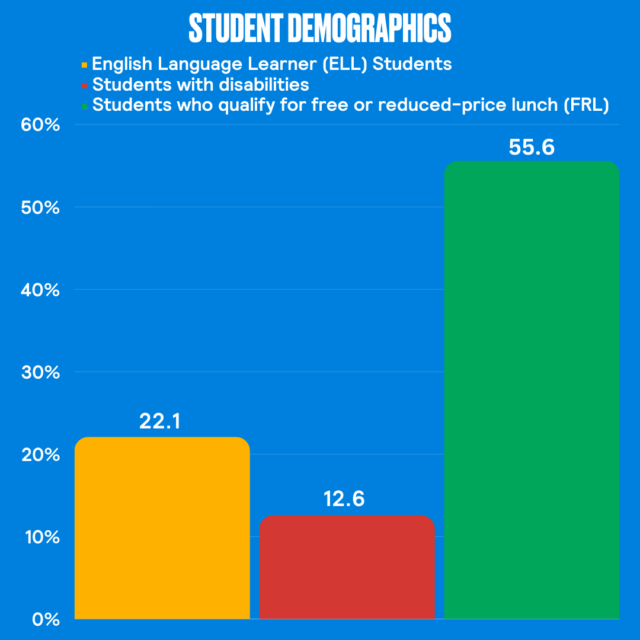
-
- Number of students served: 24,667
- Percentage of English language learner (ELL) students: 22.1%
- Percentage of students with disabilities: 12.6%
- Percentage of students who qualify for free or reduced-price lunch (FRL): 55.6%
- Demographics of students
- Percentage of African American students: 5.5%
- Percentage of American Indian or Alaska Native students: 0.4%
- Percentage of Asian students: 10.2%
- Percentage of Filipino students: 5.4%
- Percentage of Hispanic or Latino students: 57.1%
- Percentage of Pacific Islander students: 1.1%
- Percentage of White students: 16.3%
- Percentage of students who identify as two or more races: 3.9%
- Number of students served: 24,667
5. Arts course information (2023–24)
-
-
- Total number of arts courses offered through the district: 41
- Total number of students enrolled in arts courses: 7,592 (students enrolled in at least one art course, which includes middle school).
-
Program Description
Manteca Unified School District’s arts education programming began as a collective effort from multiple schools within the district; arts education began as a priority in the high school grades, and then trickled down to the middle school and elementary school levels. In Manteca, the district has a historically strong band program in their high schools, becoming one of the largest bands in the state in the 1960s. This musical legacy fueled the desire to develop arts programs in their middle and elementary schools, so students were prepared to join the band when they entered high school. This success fueled the district to begin expanding access to music education by focusing on bringing band and choir programs to middle schools and then to elementary schools in the district.
In 2018, the district undertook an initiative to rewrite its strategic arts plan. The district arts executive director and visual and performing arts (VAPA) coordinator recognized the need for a thoughtful plan to support their existing programs that also potentially pushed the district to expand arts programming further than music. However, the onset of the COVID-19 pandemic delayed these efforts. After the pandemic, Manteca Unified revisited the ideas and successfully completed their strategic arts plan.
Through this strategic planning process, staffing changes were made to expand the arts education programming districtwide. Instead of utilizing teacher release time, a full-time VAPA certified coordinator position was established to support VAPA department operations and faculty. Manteca Unified now has a dedicated VAPA coordinator, a former arts teacher, to help guide decisions related to the arts in schools across the district. Districtwide, there are 47 FTE certified arts teachers, including 26 music teachers. Each high school has three visual arts teachers and a theatre teacher depending on their needs. In addition, the district recently hired their first credentialed dance teacher. Outside of credentialed teachers, the district also has school sites working with an artist-in-residence program, bringing in artists to co-teach alongside classroom teachers. These artists work with teachers at specific school sites to offer English language arts or social science lesson that integrate arts. This work has led to an incredible increase in the number of arts classes offered in the district. In 2018, the program had 22 classes, which grew into 86 classes in 2022–23.
Funding for the Arts
Manteca Unified has prioritized setting aside a portion of funding for their arts program. Since 2018, the district has spent about $130,000 per year on music instrument acquisition, instrument repairs, and sheet music, which was budgeted in from general funds. The district allocated funding to schools based on a formula: for a school of X size, X% of students participate in band and will need X number of instruments. Then, they looked at their inventory to narrow down the actual demand. The district aims to provide instruments for every student in need and coordinates with the financial staff to be equitable across school sites.
Scheduling for the Arts
In Manteca Unified’s high schools, the principals are responsible for scheduling arts programming because each school site has dedicated teachers. At the elementary and middle school levels, the music teachers work between two to three school sites depending on the size of the schools; thus, they coordinate with the principals to create their own schedules. This allows them to build in time for travel between sites. The VAPA coordinator plays a supporting role as needed if there is a conflict between the music teachers and principals.
Professional Learning for the Arts
The district holds Quality Instruction Standards Assessment meetings to offer collaborative time for teachers and leaders to discuss instruction and assessment across many instructional disciplines, including arts education. They also organize monthly professional learning communities (PLCs) for visual arts, ceramics, drama, high school music, elementary school music, and choir to ensure their curricula are high quality and meet rigorous standards. These PLCs allow teachers to share ideas, plan lessons, resolve challenges, and ensure alignment across schools.
Challenges Faced when Planning and Implementing Arts Programming
Manteca Unified faced challenges while planning for and implementing its arts programs, especially regarding finding the time to prioritize arts with other competing priorities. Like so many districts, there is limited time for arts education and is sometimes perceived as “enrichment programs” because schools needed to spend more time preparing students for state assessments in math and English language arts. In prior years, some teachers would restrict students from attending music classes if they missed homework. Manteca Unified responded by creating a directive stating students need access to music and that access cannot be denied. Similarly, the district struggled with ensuring equitable access to music for all students. To remedy this inequity, they allocated more funding for instruments to allow any student to participate, regardless of the family’s income level. In visual arts, students were previously required to contribute a material fee to help cover the cost of consumable supplies. Acknowledging that the fee was a potential barrier to student participation, Manteca Unified eliminated the fee and now dedicates a part of their overall budget for visual arts teachers to purchase those materials.
Community Engagement in the Arts
As a school district, Manteca Unified connects with their community through a variety of activities. The district includes community representatives on their arts committee, and the community band and mural programs stem from the arts programs in the schools, serving to beautify the community. Additionally, they have built strong connections with their community through their mariachi program. Parents want to help or listen to the music, even during rehearsals. Many community members have volunteered to lead these programs, including a retired band director who volunteers three to four days a week working with students, and a vocal coach who participates and works with the students on their singing. In 2023, the district will offer its first mariachi class at a school. In the future, Manteca Unified hopes to connect with other cultural groups in the area to form new partnerships.
“A lot of students said their experience in the arts was the reason they came to school or why they finished.”
Student Impact
Although Manteca Unified does not collect quantitative data on student perspectives, Anthony Dahl knows from his experience as a teacher that, “A lot of students said their experience in the arts was the reason they came to school or why they finished.” Dahl recalled that participation in art class prevented one student from getting expelled. The student was able to graduate and go on to a trade school. After graduation, many students from Manteca Unified have gone on to pursue music in college and many of them also participate in the community band. Dahl shared that “Arts gave students direction.” As a testament to the power of arts education in Manteca Unified, the district currently employs seven alumni teachers within the VAPA department, and several more are currently enrolled in teacher training programs with the hopes of returning to teach in the coming years.
Appendices
- Manteca Unified LCAP
- Manteca Strategic Plan
- Visual and Performing Arts Coordinator TOSA Duty Statement
- Visual and Performing Arts in MUSD
- In the Classroom: Building Community Through Music Education
This profile was made possible by the generous support of the William and Flora Hewlett Foundation and developed by Create CA, WestEd, California County Superintendents Arts Initiative, Association of California School Administrators, California Latino School Board Association, and the Small School Districts Association.


 Create CA is a 501(c)(3) nonprofit organization.