
The following is part of a series of profiles highlighting various local education agencies’ (LEAs) efforts to develop quality arts education programming for their students. These profiles intend to support LEAs in generating ideas for effective arts programming that school leaders could implement with Prop 28 funding in different contexts.
Val Verde Unified: Aiming Beyond an Art Class
Overview
Val Verde Unified is located in Riverside County and operates 22 schools from elementary to high school. Of the close to 20,0000 students served, over 90% are either Hispanic or African American. Part of the district covers a more densely populated urban area, whereas other parts of the district are in more rural farm areas. The district has a history of a strong music program across the district, with multiple awards to show for it, but there is more going on at Val Verde. Val Verde Unified’s goal is ensuring that each of the approximately 20,000 students across the district have access to music and other art forms. How do they find the staff, time, and resources to meet this goal? Read more in the profile below to find out.
Background Information
- Regional information
- District Name: Val Verde Unified
- County Name: Riverside County
- California County Superintendents Service Region: Region 10
- School information
- Number of Schools: 22
- Urban, rural, suburban classification: Urban
- Teacher information (2021–22)
- Total number of teachers in district (2022–23): 934
- Total number of full-time equivalency (FTE) teachers: 864.5
Table 1. Snapshot of 2021–22 Teaching Assignment by FTE: Val Verde Unified
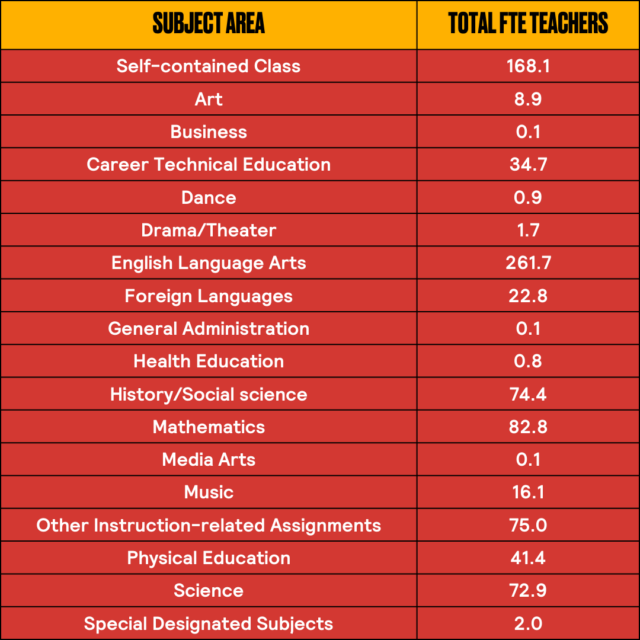
Data from the California Department of Education. Retrieved October 3, 2023, from https://dq.cde.ca.gov/dataquest/DQCensus/TchAssgnOutcome.aspx?agglevel=District&cds=3375242&year=2021-22.
4. Student information (2022–23)
-
- Number of students served: 19,379
- Percentage of English language learners (ELL) students: 21.8%
- Percentage of students with disabilities (2023–24): 11%
- Percentage of students who qualify for free or reduced-priced lunch (FRL) students: 87.3%
- Demographics of students
- Percentage of African American students: 11%
- Percentage of American Indian or Alaska Native students: 0.2%
- Percentage of Asian students: 1.5%
- Percentage of Filipino students: 1.1%
- Percentage of Hispanic or Latino students: 79.8%
- Percentage of Pacific Islander students: 0.2%
- Percentage of White students: 3.7%
- Percentage of students who identify as two or more races: 1.8%
- Number of students served: 19,379
5. Arts course information (2023–24)
-
-
- Total number of arts courses offered: 258
- Total number of students in arts courses: 3,622
-
Program Description
When talking to Allyson Huntsman and Doug Henderson at Val Verde Unified School District, one thing is clear: Val Verde is grounded in its mission to further arts education in the district. Huntsman is a visual and performing arts (VAPA) teacher on special assignment who often works with Henderson, Director of STEAM, to oversee and support visual and performing arts teachers across the district. The district’s VAPA mission is to go beyond an arts class. “We inspire our students to be lifelong learners.” The district has a history of a strong music program across the district, with multiple awards to show for it, but there is more going on at Val Verde. Henderson and Huntsman shared, “A high priority in Val Verde is prioritizing future grades. We want to strengthen the health of the whole child, and we know that art is a perfect way to satiate that.”
Arts Access via Career and Technical Education Certification
Val Verde Unified’s goal is ensuring that each of the approximately 20,000 students across the district have access to music and other art forms. Val Verde employs about 50 certified VAPA teachers in elementary, middle, and high schools, as well as performing arts assistants. A few years ago, the district focused on how to bring in artists from different industries into the teaching world, and they have done so largely using the career and technical education (CTE) certification pathway. Huntsman observed, “These teachers can bring in real work experience, and I can support them with classroom management.” They have been able to grow their elementary music team so that all 1st through 5th grade classrooms receive weekly music class. In addition, they brought in more after school programming to offer dance and theater options, and they worked with music, visual arts, and STEAM teachers to bring arts into middle school classrooms. CTE programs are used at both the middle and high school levels. Utilizing the CTE credential pathway has been a way for the district to find additional staff members, especially in arts disciplines. Henderson shared, “A few years ago we created a CTE salary schedule, which allows us to cast a wider net to get more people to come in.” The district has brought in artists from other industries, such as the dance industry or graphic design, to become certified through the CTE salary schedule. “We can teach them how to run a classroom, and these teachers bring in real work experience,” according to Henderson. Val Verde has also used the CTE teaching certification as a pathway for existing teachers to reimagine their position, for instance, certified English teachers becoming credentialed to teach arts programming such as dance.
Equitable Access to Supplies, Facilities, and Supports for the Arts
Schools are responsible for requesting what materials and equipment are needed at their individual sites, which rolls up to the district level. Henderson shared, “I look at requests through a district lens. Is this a broader need? Is this something that’s needed in all programs at all sites?” Schools largely buy their own materials and supplies, but the district looks wholistically at bigger equipment purchases, such as musical instruments. The district approaches challenges with facilities in a similar manner. Across the district, its 22 schools have different needs related to facilities. At some sites, arts teachers rotate through classrooms, co-teach, or share a classroom with another visual and performing arts teacher. In 2023, the district hired additional arts staff based on upcoming Prop 28 funds; however, additional funding will now be needed to find classroom space. Both Henderson and Huntsman have a lens of student equity when looking at requests, ensuring that in a district where many families are living in poverty, accessing arts education should not be dependent on whether a family can afford to pay for it.
“The district has brought in artists from other industries, such as the dance industry or graphic design, to become certified through the CTE salary schedule.”
For Huntsman, her role at the district includes ensuring arts education programs are standards-based and high-quality across all school sites. “I work with a lot of programs at all sites.” When not on-site herself, she is connecting teachers across sites to work on shared benchmarks and assessments and ensuring vertical alignment by asking questions like, “What does a 5th grader need to be ready for 6th grade band?” In her role, she tunes into identifying teacher needs, is present to offer support, and finds resources to help teachers fill in the gaps.
Program Impact on Students and Families
Val Verde Unified has spent time ensuring they are responding to community needs and ensuring community members feel heard. They have seen the benefits of doing so. Henderson noted, “I’ve heard from parents they appreciate the creative outlet we have for our kids.” Parents and alumni attend art shows and music performances. Beyond connecting with parents and families, Val Verde has partnered with organizations like the Riverside Art Museum and cities within the district boundaries to solicit feedback and form new partnerships.
Huntsman reflects on her experience: “As a former arts teacher, I know that many arts programs become home for students. For a lot of students, their first stop in school is the art classroom and it’s the last place they visit before they leave.” Val Verde staff see that arts programs have given many students the opportunity to thrive and blossom, and many students are taking their love for and engagement in the arts beyond their high school graduation. Val Verde alumni have gone on to pursue careers in the arts, from video production to music. Henderson shared that the arts have brought students in the district “a sense of community, acceptance, and belonging.”
Appendices
- Val Verde LCAP
- VVUSD VAPA Website
- CTE Pathway Brochure
- VVUSD Strategic Arts Education Plan: 2023-2028
- VVUSD Arts Plan Infographic
This profile was made possible by the generous support of the William and Flora Hewlett Foundation and developed by Create CA, WestEd, California County Superintendents Arts Initiative, Association of California School Administrators, California Latino School Board Association, and the Small School Districts Association.


 Create CA is a 501(c)(3) nonprofit organization.