
The following is part of a series of profiles highlighting various local education agencies’ (LEAs) efforts to develop quality arts education programming for their students. These profiles intend to support LEAs in generating ideas for effective arts programming that school leaders could implement with Prop 28 funding in different contexts.
Elk Grove Unified School District: Building a Roadmap to Arts Success
Overview
Elk Grove Unified is the fifth-largest school district in California, covering 320 square miles and serving 68 total schools across elementary and secondary levels. Located in Sacramento County, the district has a diverse population of students and families, 45% of which are socioeconomically disadvantaged. Elk Grove has created an Arts Education Roadmap, based on a desire from the community and staff to build up arts programming at the elementary level in the district. This Roadmap includes four main goals, actionable items, and ways to measure progress on each goal through 2024. Learn more about how this Roadmap has helped guide Elk Grove in the profile below!
Background Information
- Regional information
- District Name: Elk Grove Unified School District
- County Name: Sacramento County
- California County Superintendents Service Region: Region 3
- School information
- Number of Schools: 69
- Urban, rural, suburban classification: Urban
- Teacher information (2021–22)
- Total number of teachers in district: 3,535
- Total number of full-time equivalency (FTE) teachers: 3,037.5
Table 1. Snapshot of 2021–22 Teaching Assignment by FTE: Elk Grove
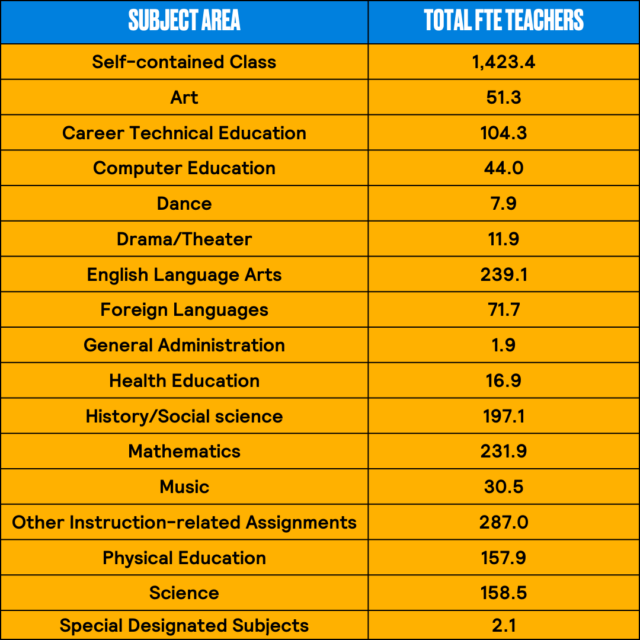
Data from the California Department of Education. Retrieved October 3, 2023, from https://dq.cde.ca.gov/dataquest/DQCensus/TchAssgnOutcome.aspx?agglevel=District&cds=3467314&year=2021-22
4. Student information (2022–23)
-
- Number of students served: 62,957
- Percentage of English language learner (ELL) students: 16.5%
- Percentage of students with disabilities: 13%
- Percentage of students who qualify for free or reduced-price lunch (FRL): 42.2%
- Demographics of students
- Percentage of African American students: 10.3%
- Percentage of American Indian or Alaska Native students: 0.4%
- Percentage of Asian students: 28.7%
- Percentage of Filipino students: 5.8%
- Percentage of Hispanic or Latino students: 27.8%
- Percentage of Pacific Islander students: 1.9%
- Percentage of White students: 15.9%
- Percentage of students who identify as two or more races: 9.3%
- Number of students served: 62,957
5. Arts course information (2022–23)
-
-
- Total number of arts courses offered: 95 (secondary only)
- Total number of students in arts courses: 29,590 (secondary only)
-
Program Description
Elk Grove Unified School District’s vision for visual and performing arts is “to ensure ALL students engage in a comprehensive Visual and Performing Arts education that fosters students’ creativity, individuality, and academic potential to inspire and resonate throughout their education, career, and life.” The district has included arts in its schools from the beginning, including having arts as part of its course requirements in secondary schools across the district. Over time, a deeper desire emerged from the community and staff to build up arts programming at the elementary level, which led to the district’s creating its Arts Education Roadmap. This Roadmap includes four main goals, actionable items, and ways to measure progress on each goal through 2024. Jennifer Wilbanks, Director of Instructional Support, shared, “We call it a roadmap because we want to articulate the fact that there could be twists, turns, and forks in the road to which we may need to adjust and adapt along the way.”
As one of two the Directors of Instructional Support in the Curriculum and Professional Development Department, Wilbanks oversees instructional supports across the district, including arts programming in PreK through 12th grade. In addition, the district recently hired four visual and performing arts (VAPA) curriculum specialists for arts education to support arts instruction and curriculum districtwide. Elk Grove employs around 140 arts teachers in its secondary schools who serve all five arts disciplines and additional career and technical education (CTE) staff who offer arts-related CTE courses. At the elementary level, classroom teachers are including arts programming within their instruction; however, this is harder to measure. Elk Grove’s vision is to bring the high-quality arts programming happening at the secondary level to the elementary level as well.
Elk Grove relies heavily on the California Arts Education Framework and utilizes the staff at the district level, such as Wilbanks and the four curriculum specialists, to provide training to arts teachers at the secondary and elementary levels. Elk Grove has been working to build the capacity of school-level teams, and although it has established a solid foundation, it also sees the need to continue what it has started.
Creating a Roadmap for the Arts
Before drafting the Arts Education Roadmap, the district established an arts planning team comprising district staff, parents, and community members. During a 6-month planning period, this group discussed what components should be included in an arts education roadmap and set a vision for how they wanted arts education to expand and grow in the district. Within the Roadmap, they identified a need for an additional staff member at the district level to support implementing the plan. Wilbanks, who was a school site principal at the time, moved into this role, utilizing her expertise of implementing arts programming at the site level. This arts planning team is still an asset the district taps into, and there are plans to include student representation on the team in the future. With the current Roadmap going through 2024, the team will begin the strategic planning process again to update and revise the Roadmap for the next 5 years.
Historically, Elk Grove has had strong arts programs at its secondary schools. Staff identified a desire, from both students and families, to build up arts programing in their elementary schools through their roadmap planning process. As part of the Roadmap, the district has started forming partnerships with organizations that support bringing teaching artists into elementary classrooms. In the 2022–23 school year, over 100 classrooms in the district had teaching artist support to offer visual arts, theater, and other social–emotional artistic support, which aligned with standards. Elk Grove has worked with organizations such as the Mandarins Music Academy and the NorCal School of the Arts and CLARA Classroom program to bring art experiences to all students. Its vision moving forward, with the support of Prop 28 funding, is to hire full-time art teachers at the elementary level to support arts instruction in all five arts disciplines. According to Wilbanks, “We realize that it will be difficult to hire the number of teachers needed in both elementary and secondary during the first few years of the Prop 28 implementation. But we will develop a multi-year plan, which will include the use of teaching artists, to address this.”
Funding for the Arts
As it is in many districts, Elk Grove has maximized what is often limited funding for the arts. This has presented an opportunity for the district to utilize resources in a creative way. Wilbanks shared, “The roadmap identifies budget and resources as one of the priority areas. Our goal is to secure, maximize, and allocate funds to support and sustain Pre-K-12 arts education.” The district has thought creatively about funding in the past, addressing some of this with ESSER funding, collaborating with the grant program office, and collaborating with community organizations.
Elk Grove is known for its high-quality music programming at the secondary level, and with any music program, managing the instruments and other materials can be costly and complex. In Elk Grove, the district offers support. Currently, sites receive a VAPA allocation each year and spend it on the needs of their arts programs, including music. Funding recommendations are based on a collaborative process. Wilbanks explained,
“During the pandemic, we also took advantage of ESSER funds and spent money on visual and performing arts. We wanted to support students and have them back in classrooms and feel welcomed. Our arts programs supported our students social and emotional well-being as we reopened our schools.”
Scheduling for the Arts
Elk Grove approaches scheduling similarly to how it approaches funding arts materials and equipment: School sites largely have autonomy over their own schedules and determine how many arts courses and full-time employees are needed. Within her role, Wilbanks has a direct line to administrators and art teachers to support school sites throughout the school year. At secondary campuses in Elk Grove, arts schedules look similar, and no teachers are shared across school sites. At the elementary level, scheduling is more complicated when it comes to working with classroom teachers on how to fit arts education into their schedules. The newly hired VAPA curriculum specialists support elementary teachers with scheduling, professional development, and working with teaching artists brought into the elementary school sites.
Art Facilities
Across the district, the spaces at each school site dedicated to arts differ. Elk Grove conducts a needs assessment to see what facilities and spaces are needed as it grows its elementary arts programming, looking at classroom spaces as well as storage spaces for materials and equipment. For those school sites with performing arts centers, Elk Grove has a process to ensure other schools and community members can access or rent out the space by contacting the district. The district has thoughtfully considered how to use funding to update facilities to ensure all student needs are met.
Program Impact on Students and Families
Elk Grove has engaged the community in many ways, including in the development of its Arts Education Roadmap. The process of engaging the community in its roadmap planning has given the district an opportunity to connect with families and meet with community members regularly to build deep connections. Wilbanks stated, “It is an opportunity [to] share with families so they can understand the California arts standards and framework and they can advocate on behalf of students.” Beyond that, Elk Grove connected with families through family art nights; presented its Roadmap in district board meetings; and worked closely with other teams within its district, such as the family engagement department and communications department, to showcase the incredible work happening related to arts education in its district. Wilbanks works closely with the district’s communication staff to ensure that arts news is published through communication vehicles such as their newsletters and website to ensure that the community can see the great work happening on school sites related to the arts.
Elk Grove is looking for ways to measure the impact these changes to their arts programming are having on students. It will be looking at the graduation rates of students enrolled in arts programming and to what extent students stay in arts classes over all four years of their high school experience. Based on data thus far, enrollment in their secondary arts programming has increased over time, which likely reflects students’ desire to participate in the arts programs offered. At the elementary level, Elk Grove is starting to hear a similar story. Wilbanks shared, “In elementary, students are excited to be engaging in the arts and we are currently collecting data on the programs that have been implement[ed]. We can see [the arts programming] has value.” Seeing that value is inspiring Elk Grove to continue to build and expand its arts offerings.
Appendices
This profile was made possible by the generous support of the William and Flora Hewlett Foundation and developed by Create CA, WestEd, California County Superintendents Arts Initiative, Association of California School Administrators, California Latino School Board Association, and the Small School Districts Association.


 Create CA is a 501(c)(3) nonprofit organization.