
The following is part of a series of profiles highlighting various local education agencies’ (LEAs) efforts to develop quality arts education programming for their students. These profiles intend to support LEAs in generating ideas for effective arts programming that school leaders could implement with Prop 28 funding in different contexts.
Mountain View Elementary: Leveraging Community Partnerships
Overview
Mountain View Elementary is a school district located in El Monte, east of Los Angeles. The district operates a total of eight school sites, including three K–8 schools, four K–6 schools, and one K–3 school. Situated in a densely populated area with substantial economic needs, the Mountain View Elementary community is predominantly Hispanic/Latino, with a growing Asian population. The population is quite dense, with some school sites being only a few blocks from another. Recently the district has gradually diversified its art course offerings by collaborating with other community organizations to add dance, visual arts, and music to more students throughout their district. Mountain View has been able to expand its arts programming so that every grade level from kindergarten to 8th grade receives arts education. These partnerships have brought their community together with a lot of support from teachers, parents, and their board. Learn more about how Mountain View has leveraged community partnerships to prioritize art education in the profile below!
Background Information
- Regional information
- District Name: Mountain View Elementary (1964816)
- County Name: Los Angeles County
- California County Superintendents Service Region: Region 11
- School information
- Number of Schools: 8
- Urban, rural, suburban classification: Urban
- Teacher information (2021–22)
- Total number of full-time equivalency (FTE) teachers: 275
- Classroom teachers: 248
- Support Staff (TOSAs, Program Specialists): 10
- Intervention teachers: 15
- Total number of full-time equivalency (FTE) teachers: 275
Table 1. Snapshot of 2021–22 Teaching Assignment by FTE: Mountain View Elementary
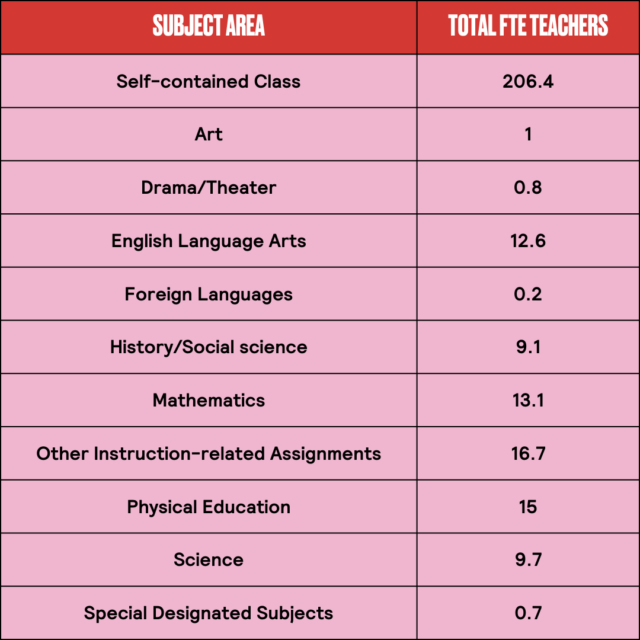
Data from the California Department of Education. Retrieved October 3, 2023, https://dq.cde.ca.gov/dataquest/DQCensus/TchAssgnOutcome.aspx?agglevel=District&cds=1964816&year=2021-22.
4. Student information (2022–23)
-
- Number of students served: 4,944
- Percentage of English language learner (ELL) students: 49.7%
- Percentage of students with disabilities: 12.4%
- Percentage of students who qualify for free or reduced-price lunch (FRL): 79.7%
- Demographics of students
- Percentage of African American students: 0.4%
- Percentage of American Indian or Alaska Native students: 0.1%
- Percentage of Asian students: 5.3%
- Percentage of Filipino students: 0.3%
- Percentage of Hispanic or Latino students: 93.4%
- Percentage of Pacific Islander students: 0%
- Percentage of White students: 0.4%
- Percentage of students who identify as two or more races: 0%
- Number of students served: 4,944
5. Arts course information (2018–19)
-
-
- Total number of arts courses offered: 14
- Total number of students in arts courses: 409
-
Program Description
Over the past 8 years, Mountain View Elementary District’s art program has undergone significant expansion and transformation. The district is located in a population-dense community east of Los Angeles where many families have significant economic needs. Close to 80 percent of students in the district qualify for free or reduced-price lunch, and close to half the student body are identified as English language learners. In 2015, the district began its journey into arts education by writing and receiving a grant from the LA County Arts Education Collective’s (Arts Ed Collective) Advancement Grant program. At that time, its vision was simple: bring arts education into elementary schools in the district in some way. Through the grant, the school developed a puppetry program to serve 2nd grade students. The program saw immediate success, and it was clear that expanding the program would be beneficial. “When we were doing evaluations of this artist residency, it was clear that teachers loved it, saw the value, and our kids loved it too.” Dr. Lagozzino, Assistant Superintendent of Educational Services, shared that he realized the district needed to offer different art forms to 3rd and 4th grade to diversify their artists residencies.
Expansion Through Partnership
Although puppetry was the initial focus, the district gradually diversified its program offerings by collaborating with other community organizations, such as the LA Arts Group, to add dance, visual arts, and music to 3rd and 4th grade classrooms. With teachers and students alike finding value in these arts programs, the district continued to seek out partnerships and partnered with Conga Kids and their in-school residency program, which expanded dance to 5th and 6th grades. Dr. Lagozzino shared that their art program brought their community together with a lot of support from teachers, parents, and their board. Currently, Mountain View Elementary School District provides diverse and inclusive arts program offerings to all its K–6 students with classes in music, mime, drumming, dance, and theatre.
When Mountain View Elementary initially began its programming with the Arts Ed Collective grant, it was provided a strategic planning coach to support development of a district arts plan. This coach helped Mountain View organize an arts council inclusive of parents, teachers, and classified staff. This council met over several months to narrow down their priorities, with the goal of hiring an art director at the district level. The council also started the idea of designating teachers at school sites as arts leads. These leads are trained to be the go-to staff members should any problem or need arise at the school site related to arts education. The district also partners with art residency providers (such as LA Arts Group) to bring teaching artists to its schools. At the beginning of each school year, teachers and teaching artists meet to discuss and plan their lessons together. Additionally, the district provides an art therapist who works with teachers, counselors, community liaisons, and parents to organize art activities. By using a combination of FTE arts teachers, arts leads (teachers at school sites with extra responsibilities), and artist residencies, Mountain View has been able to expand its arts programming so that every grade level from kindergarten through 8th grade receives arts education with art electives offered to 7th and 8th grade students.
“Students are joyful and engaged and always look forward to having the teaching artists in their classroom. The impact of arts education in the district is long lasting”
Scheduling for the Arts
Mountain View Elementary School District has a flexible scheduling approach depending on its partners. Its main art program provider, LA Arts Group, has a good relationship with the school principals and works directly with the schools to coordinate their offerings. The LA Arts Group coordinator actively plans the district program schedule based on their artist schedules and the schools’ needs. For drumming, the district art director is responsible for scheduling.
Program Impact on Students and Families
One way Mountain View Elementary School District has measured the impact of arts education on students is through conducting student surveys as part of its Local Control Accountability Plan. “Arts is always something students rate very highly,” Dr. Lagozzino observed. Students are joyful and engaged and always look forward to having the teaching artists in their classroom. The impact of arts education in the district is long lasting. According to Dr. Lagozzino, “We take students to a summer camp in junior high. On one of these trips there was a social night with a DJ[,] and students could request any song they wanted. Kids were asking for songs that they used in their arts education Conga class years ago.” Students practiced the swing dance they learned through Conga Kids and taught their camp counselors and other students who did not participate in the program. By creating partnerships with community organizations and engaging teaching artists, evidence shows that Mountain View is impacting students well beyond their time in the district.
Appendices
- Mountain View Elementary LCAP
- Mountain View Elementary Arts Strategic Plan
- MVSD VAPA Strategic Plan Deck
- Mountain View Elementary Artists in Residencies
- MSVD Arts for All Story Deck
This profile was made possible by the generous support of the William and Flora Hewlett Foundation and developed by Create CA, WestEd, California County Superintendents Arts Initiative, Association of California School Administrators, California Latino School Board Association, and the Small School Districts Association.


 Create CA is a 501(c)(3) nonprofit organization.